Madrid–Barajas Airport Terminals Guide
Adolfo Suárez Madrid–Barajas Airport (MAD) is the largest airport in Spain and one of the most important aviation hubs in Europe. Located about 12 km northeast of Madrid’s city center, the airport serves more than 60 million passengers per year and connects Spain with destinations across Europe, the Americas, Africa, and Asia.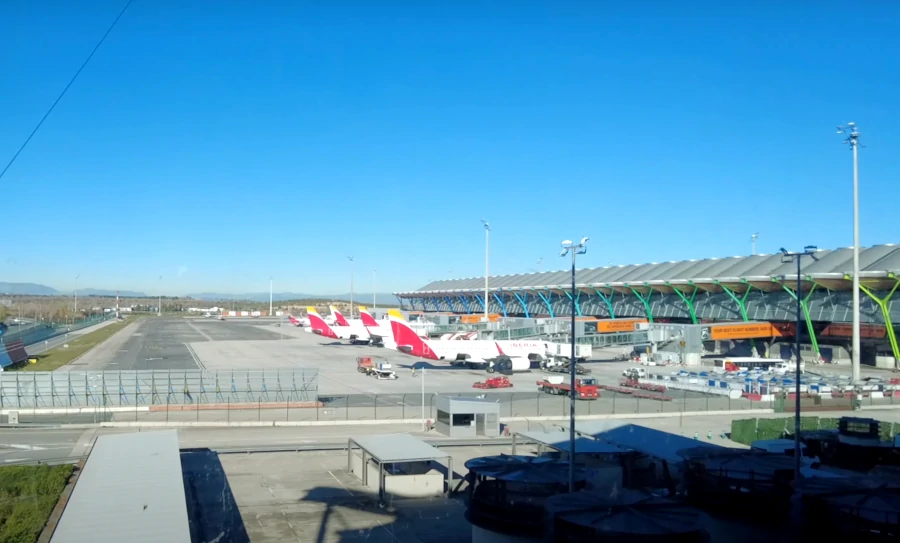
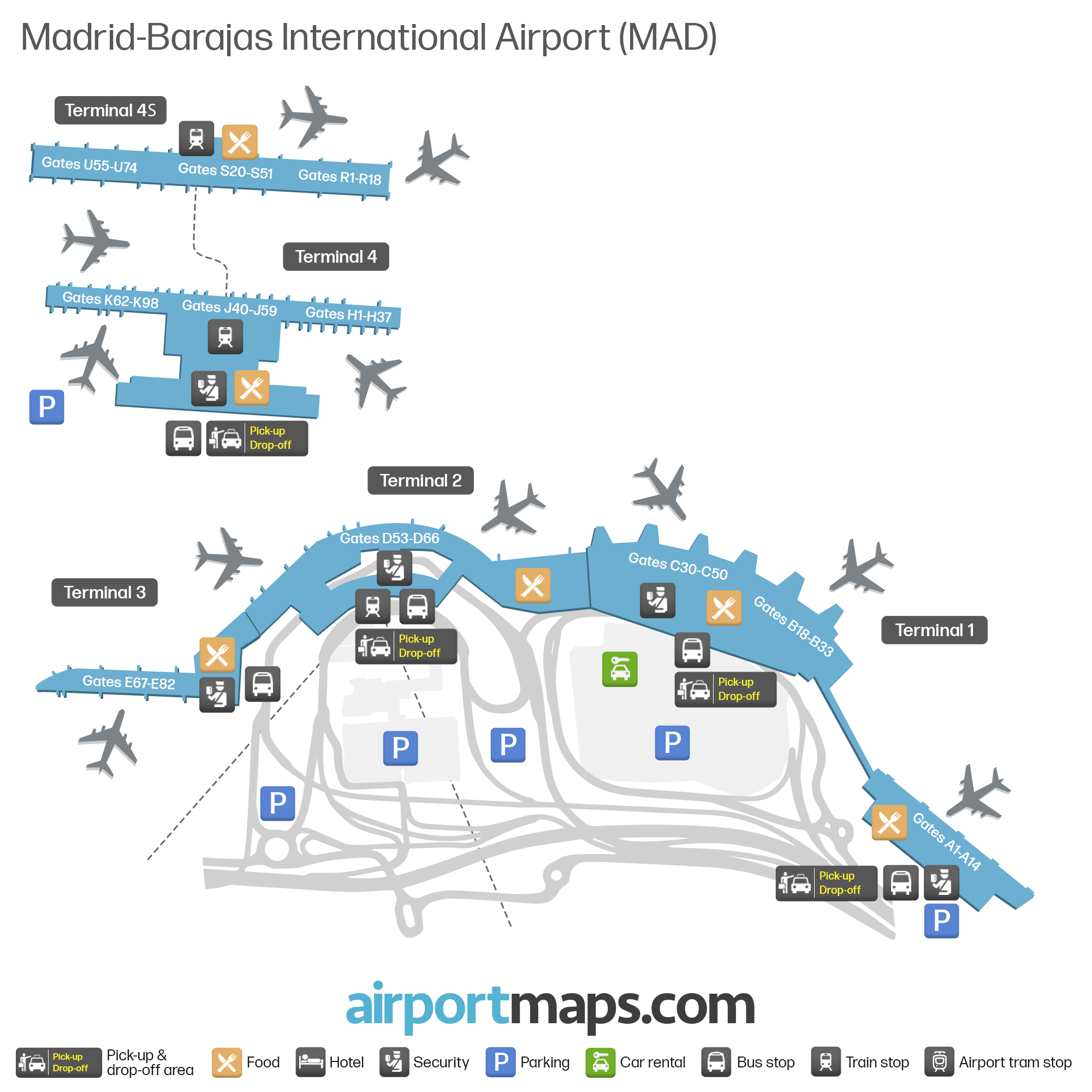
The airport operates with four passenger terminals: T1, T2, T3, and T4. Each terminal handles different airlines and flight types, with Terminal 4 being the newest and largest facility. Together, these terminals provide modern infrastructure, extensive shopping areas, restaurants, lounges, and transport connections.
Allow extra time when traveling through Terminal 4. It is the largest terminal and walking distances can be longer than in the older terminals.
Terminal 1
Historical Background
Terminal 1 opened in the 1950s as Madrid Airport began expanding to accommodate growing international traffic. Over the decades, it has undergone several renovations and remains an important terminal for many international airlines.
Terminal Layout
Terminal 1 has multiple passenger levels:
- Ground Level: arrivals, baggage claim, transport access
- Upper Level: check-in counters and security screening
- Boarding areas: gates for international and European flights
The terminal includes a mix of shops, restaurants, airline counters, and passenger services.
Shops
- Duty Free: Madrid Duty Free, Express Duty Free
- Fashion & accessories: Parfois, Natura
- Travel essentials: WHSmith
- Electronics & accessories: Betelphone
Restaurants and Cafés
Popular dining options include:
- La Barra de la Bientirada – Spanish tapas and wine bar located near the boarding gates.
- Sibarium – Mediterranean-style cuisine with sandwiches and salads.
- Starbucks – coffee, pastries, and quick snacks.
More info about restaurants and shops
If you want authentic Spanish food before your flight, try tapas bars such as La Barra de la Bientirada.
Terminal 2
Historical Background
Terminal 2 opened in the 1960s and has traditionally been used for domestic and European flights. Today it serves many airlines operating within Europe and the Schengen Area.
Terminal Layout
- Arrivals Level: baggage claim, customs, transport connections
- Departure Level: check-in desks and security screening
- Boarding concourse: gates serving mainly European destinations
Shops
- Duty Free: Express Duty Free
- Fashion & accessories: Parfois
- Convenience stores: small travel shops and kiosks
Restaurants and Cafés
- Enrique Tomás Experience – famous for Iberian ham and Spanish tapas.
- Rodilla – sandwiches and quick meals.
- Paul Bakery – French bakery with pastries and coffee.
Enrique Tomás Experience is one of the best places at the airport to taste Spanish Iberian ham.
Terminal 3
Historical Background
Terminal 3 opened in 1971 and today functions as an extension of Terminal 2. It mainly handles regional flights and some domestic routes.
Terminal Layout
The terminal is smaller than the others and mainly provides boarding gates and limited passenger services.
Restaurants and Cafés
- Pannus – bakery and sandwiches.
- Breadway – coffee and quick breakfast options.
Terminal 4
Historical Background
Terminal 4 opened in 2006 and was designed by architect Richard Rogers. It is one of the most modern and architecturally impressive terminals in Europe.
The terminal serves as the main hub for Iberia and its oneworld alliance partners.
Terminal Layout
- Level 0: arrivals and baggage claim
- Level 1: security and shopping area
- Level 2: check-in counters
- Satellite building (T4S): long-haul international flights
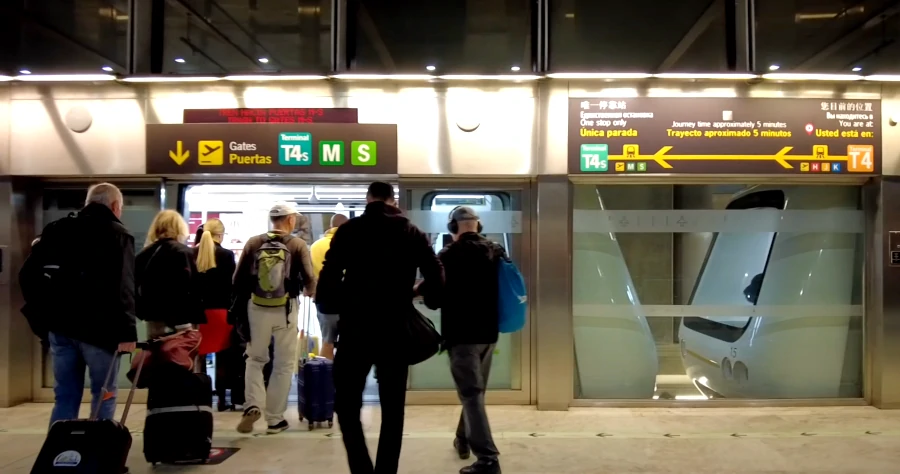
International flights at Terminal 4 often depart from the T4 Satellite building. A short underground train connects both buildings in about 3 minutes.
Shops
Terminal 4 has the largest shopping area in the airport.
- Duty Free: Madrid Duty Free
- Fashion: Lacoste, Desigual, Mango, Boss
- Accessories: Tous, Majorica, Uno de 50
- Travel essentials: WHSmith, Samsonite
Restaurants and Cafés
- Flax & Kale – healthy Mediterranean cuisine.
- La Bottega del Tartufo – Italian cuisine and truffle specialties.
- Oliva & Bellota – Spanish tapas and Iberian ham.
Airport Facilities
- Free Wi-Fi throughout all terminals
- ATMs and currency exchange in arrivals and departures
- Luggage storage services available in Terminal 1 and Terminal 4
- Charging stations for electronic devices
Family and Accessibility Services
- Baby-changing rooms
- Family restrooms
- Wheelchair assistance services
- Accessible elevators and ramps
Security and Baggage Control
Passengers must pass through security screening before entering the departure area. Carry-on baggage is scanned and liquids must follow international aviation regulations.
Lost and Found
If you lose an item at the airport, contact the Lost & Found office. Items lost onboard aircraft should be reported to the airline.
Check-in and Boarding
- Domestic flights: arrive 2 hours before departure
- International flights: arrive 3 hours before departure
Popular Flights from Madrid Airport
Typical Waiting Times at Madrid Airport
Transfers Between Terminals at Madrid Airport
Adolfo Suárez Madrid–Barajas Airport (MAD) has four passenger terminals: T1, T2, T3, and T4. While Terminals 1, 2 and 3 are located in the same airport area and relatively close to each other, Terminal 4 is located about 2.5 km away. Because of this layout, the airport provides several transport options to help passengers move easily between terminals.
Traveler tip: If you have a connection between Terminal 4 and the other terminals, allow at least 25–30 minutes to complete the transfer.
Airport Shuttle Bus (Free Service)
The easiest way to transfer between terminals is the free airport shuttle bus service. These buses operate 24 hours a day and connect all terminals at regular intervals.
The shuttle route connects:
- Terminal 1
- Terminal 2
- Terminal 3
- Terminal 4
During daytime hours the buses run approximately every 5–10 minutes, while during the night frequency may decrease slightly.
Stops are located outside the arrivals areas of each terminal.
Shuttle buses are free and do not require a boarding pass, making them the best option if you need to move between terminals before check-in.
Walking Between Terminals 1, 2 and 3
Terminals T1, T2 and T3 are located very close to each other and can be reached on foot.
- T1 → T2: about 10–15 minutes walking
- T2 → T3: about 5 minutes walking
- T1 → T3: about 15–20 minutes walking
These terminals are connected by covered walkways and internal corridors.
If your flight departs from Terminal 2 or 3, check the exact gate area because some gates are located in satellite sections that require extra walking time.
Underground Train (Terminal 4 ↔ T4 Satellite)
Passengers departing from long-haul international flights at Terminal 4 often use the T4 Satellite building (T4S). This satellite terminal is connected to the main Terminal 4 building by an automatic underground train.
- Travel time: 3 minutes
- Frequency: every few minutes
- Access: after security control
This train is only available to passengers who have already passed through security and passport control.
Taxi or Ride-Hailing
If you have heavy luggage or are in a hurry, you can also take a taxi between terminals. Travel time is usually 5–10 minutes depending on traffic.
This option is less common because the free airport shuttle bus is usually faster and more convenient.
Transfer Time Overview
Summary
Moving between terminals at Madrid Airport is relatively easy thanks to the free shuttle buses, short walking distances between T1–T3, and the underground train connecting Terminal 4 with its satellite building. Planning a little extra time for transfers—especially when traveling between Terminal 4 and the older terminals—can help ensure a smooth connection.